11 Most Common SEO Myths Debunked
- Home
- Knowledge Sharing
- 11 Most Common SEO Myths Debunked
- Why do SEO myths exist?
- Myth 1: SEO Will Soon Die
- Myth 2: SEO is a One-Time Task
- Myth 3: Quick Results
- Myth 4: The More Keywords, the Better
- Myth 5: Keywords Are Not Necessary
- Myth 6: 100% Guarantee of Optimization Results
- Myth 7: Interesting and Useful Content Can Rise in Google's Rankings on Its Own
- Myth 8: Links No Longer Work
- Myth 9: Website Usability Is Not Important if There Is SEO
- Myth 10: It Is Enough to Copy Content from Other Websites
- Myth 11: SEO Can Be Done Independently
- Final Thoughts about Debunking SEO Misconceptions
SEO myths have been around nearly as long as search engines themselves. Every year, the number of these myths increases, on practically every important question you can hear different opinions.
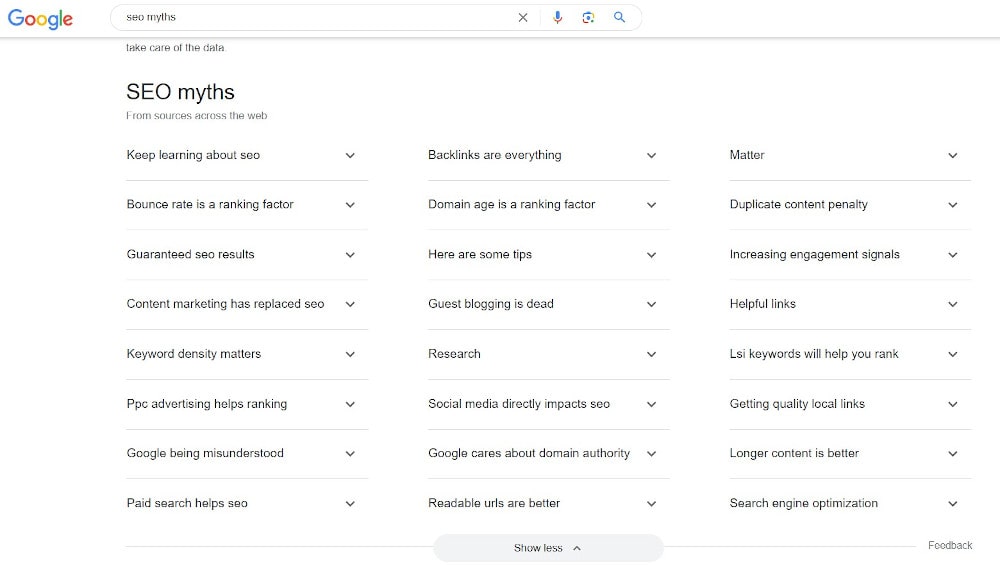
If you enter 'SEO myths' into a Google search, you'll encounter numerous statements that spark controversy and doubt on the Internet.
Let's first discuss the origins of SEO myths and why they exist.
Why do SEO myths exist?
Like any other question, there are several reasons why myths about SEO arise. Let's consider the main ones:
- Search engine algorithms are unknown. Since no one doesn't have a full picture of how search engines assign top rankings, there are no uniform precise rules for website promotion. Of course, everyone is aware of Google's webmaster guidelines - Google Search Central. However, these only outline the basic principles and recommendations for working with websites, without specific rules on how to boost a site's search ranking.
- Lack of basic knowledge of SEO Practices. Often, clients and website owners come with requests to increase traffic without a general understanding of what SEO is and the principles behind this desired traffic increase.
-
Search Engine Algorithm Updates. Any SEO specialist understands that the promotional methods that worked effortlessly 15 years ago and delivered amazing results are no longer effective today.
SEO experts with years of experience may only reminisce about these methods with nostalgia, while newcomers might not even be aware of them. Why does this happen? It's because Google, like the entire internet, is constantly evolving and striving to perfect its site ranking algorithms.
Google updates are becoming more frequent and extensive. As a result, the tricks and “hacks" that might have helped achieve top rankings for priority queries yesterday could become obsolete as ranking factors tomorrow.

- Multiple Ranking Factors. Search engine ranking algorithms consist of a large formula made up of variables, each assigned its own coefficient. These variables are known as ranking factors. There are several hundred of them, and perhaps even several thousand by now. These factors cover all aspects of a website: content, theme, technical aspects, external parameters, etc. Consequently, without knowing these formulas, no one can definitively say whether a particular parameter is a ranking factor, and if it is, how significant its impact is on the overall ranking of the site.
- Website Specifics. The internet features a countless array of website topics, types, and directions, created in multiple languages and targeted for different locations. Therefore, strategies that are effective for one website may have less impact on another, or might even be misguided for a third.
So, we have explored why SEO misconceptions emerge. Now it's time to address the most common SEO myths and debunk them.
Let's consider the most widespread and current ones – top SEO misconceptions.
Myth 1: SEO Will Soon Die
This is one of the favorite myths among SEO strategists, often joking about it and discussing where they would find work afterward. Will it die? Everything changes over time, and anything is possible. But in the near future — this is highly doubtful.
For now, SEO is very much alive and continues to help develop the Internet and businesses. Why does such a theory spread? Primarily, those who fail to achieve results in promotion spread these "rumors" as they claim the reason is the death of SEO.
Secondly, such thoughts start to emerge in the minds of specialists with every new extensive update, causing panic.
Another concern is that artificial intelligence, which is rapidly making its way onto the internet, could potentially replace both search engines and many websites. Undoubtedly, AI is significantly altering established search interaction principles. However, SEO is also constantly evolving and adapting to new innovations.
Therefore, it can be said definitively — yes, SEO methods are changing and will continue to change significantly, but it is too early to speak of its demise. This is an SEO fact.
Myth 2: SEO is a One-Time Task
Some believe that ordering an SEO service once is sufficient. This is a profound misconception. A website requires permanent work. The sites that achieve good results are those that are constantly evolving and improving.
Yes, if you order an SEO audit service and implement all the recommendations, it will indeed yield initial results and allow you to compete in your niche. But why isn't it forever?
- Success will be temporary because, as mentioned earlier, search engine algorithms are constantly changing, and the site needs to be adapted periodically.
- Competitors are also active, striving to improve their websites and capture a larger share of the traffic. Additionally, new players are constantly entering the market, taking their share of users and keeping their captured market if their competitors treat SEO as a one-time task.
- Content needs updating and development. Information on the site must be refreshed and always remain current.
- Links. One of the key principles of link building is creating a "natural" link profile and its development. It's necessary to work gradually and consistently on the site's authority and the development of external ranking factors.
Myth 3: Quick Results
Some business owners or their representatives believe that if they order website optimization today, they will have many visitors by tomorrow. This is not true. Often, people expect results from SEO similar to those from Google Ads.
However, SEO is based on entirely different methods that require more time. Nonetheless, SEO works towards long-term results, and the return on investment typically occurs after several months. With proper efforts and a well-thought-out SEO strategy, the revenue from SEO can significantly exceed the costs over time.
Myth 4: The More Keywords, the Better
No, this idea might have been valid at some point, about 20 years ago or more, when the Internet was just developing and search engine algorithms were much simpler. Back then, some specialists would create blocks with lists of keywords separated by commas and achieve good rankings. However, Google quickly caught on to such manipulations, and this no longer works.
Other “strategists" try to include a keyword 40 times in a 200-word text, thinking that quantity will help them outrank competitors. But this doesn't work either. To achieve good rankings, the quality of the content is crucial. Overstuffing keywords can lead to keyword overspam (a high keyword density) and actually decrease the chances of appearing in search results.
Myth 5: Keywords Are Not Necessary
Sometimes, you might hear opinions that Google has developed its algorithms to the point where the specific words used in content don't matter, as long as it is useful and interesting. It is indeed very important for the content to answer all relevant questions, be well-structured, interesting, and useful to the user. However, Google is not a human, Google is sophisticated high-level software based on algorithms and rules.
Since it is not a person, how can a machine understand that the content matches the query? Only through keywords that establish the topic. To improve the quality of your content, you should use not only keywords but also synonyms and LSI (Latent Semantic Indexing) terms. These enhance the readability of your text and show search bots the relevance to a wider range of queries.
Myth 6: 100% Guarantee of Optimization Results
Serious SEO experts and reputable companies will never guarantee results. SEO experts can provide an approximate forecast of expected outcomes, but they do not have the right to give guarantees.
As mentioned earlier, no one knows the exact ranking algorithms. It is also unknown when the next search engine update will be introduced. Additionally, SEO specialists develop strategies and provide recommendations for website optimization. However, these recommendations are not always fully implemented or within the given timelines.
Therefore, it is crucial to follow all optimization requirements accurately and promptly. This increases the chances that the forecasts will match the results, and may even exceed them.
Myth 7: Interesting and Useful Content Can Rise in Google's Rankings on Its Own
If content is not properly optimized and hosted on a high-quality, well-promoted site, its chances of achieving good rankings are low. It's not enough for content to be merely interesting. It is important to carry out a series of work to optimize the article to achieve the desired positions.
First, the article must include relevant phrases that users might search for, which means conducting keyword research before writing the article.
Second, the content must be well-thought-out and structured so that search algorithms consider the article informative and high-quality.
Third, the SEO strategy must be supported by a well-developed link profile.
And finally, the better developed and technically sound the site is, the better the materials posted on it will rank.
Myth 8: Links No Longer Work
For quite some time, Google has been urging users not to employ manipulative methods to increase links to a site. Buying links or participating in link schemes is forbidden by Google principles. Some of Google's updates are aimed at identifying unnatural links. Yes, it's true that links now have less influence on a site's ranking than they did 10 years ago. Sites can be penalized for spammy website practices.
Some links do not help with promotion and can sometimes lead to penalties. But this is true only if the links are indeed of poor quality.
The internet and search crawlers are designed so that search engines discover new sites, pages, and articles by following links. If authoritative sources link to your page, it has a much better chance of achieving good rankings.
Therefore, link-building strategies must be carefully planned and developed, selecting the "right" resources for your links. It's important to focus on quality in this work. It is crucial that experienced specialists handle this matter.
Myth 9: Website Usability Is Not Important if There Is SEO
Website usability refers to how easy it is for users to navigate and use the site, find all necessary information quickly and conveniently, and intuitively understand the functions of different elements. Usability is a combination of visual and technical solutions that help create a user-friendly interface, improve behavioural factors, and increase customer loyalty, ultimately boosting conversion rates on the site. Usability is closely related to SEO and serves as an additional tool for improving behavioural factors, thereby enhancing the results of SEO efforts.
The goal of SEO is to attract targeted users to the site, while the goal of usability is to retain those users and convert them into customers. If a site has an outdated design, complicated navigation, or lacks conversion elements, it usually results in the loss of potential customers.
New users often find it easier to switch to another site than to deal with confusing elements. Therefore, even at the start of your website optimization work, it is important to involve a usability expert for comprehensive, high-quality work.
Myth 10: It Is Enough to Copy Content from Other Websites
A significant mistake some webmasters make is copying content (texts and images) from other sites. This way, they quickly populate their site with a lot of thematic content and attempt to gain traffic in their niche.
Truly, with this approach in a short time, it is possible to create thousands of pages with useful content without spending much time or money creating original material. Nevertheless, this solution does not work.
Search engines have a negative view of content theft. Once new content is published and indexed, the site that originally posted it is recognized as the source. Posting someone else's content on your site can lead to search engine penalties and even removal from the index.
Myth 11: SEO Can Be Done Independently
Or developers can handle website optimization during the website creation stage.
This is another common SEO misconception. Some believe that a dedicated person for website promotion is unnecessary, and that SEO can be learned and implemented independently, or by a content manager or programmer already on staff. Basic SEO principles can be learned and understood on your own.
However, a deep and comprehensive approach to SEO involves several aspects, including site analytics, technical features, content creation, and external link-building strategies.
Understanding the differences in site themes, the nuances of algorithms, tracking their changes, and timely adapting strategies all require professional skills and extensive experience. And this is an SEO fact.
Final Thoughts about Debunking SEO Misconceptions
In this article, we covered only 11 SEO myths, but there are many more. Every issue can be approached from different angles, and the solutions will vary. It all depends on the task, the topic, the type of website, its technical aspects, and many other factors.
Misconceptions in SEO can be numerous, but the main truth about SEO is that any conclusions must be based on detailed analysis, experience, and practice. The SEO fact is that any assumptions need to be tested in practice, and then conclusions should be drawn, with the ability to adapt to search engine changes on time.
If you do not possess a sufficient level of SEO knowledge, the best solution is to consult with an experienced SEO expert or team. If you need help promoting your website online or have any other questions, feel free to contact our managers. They will be happy to help you find the best solution for developing your business.
SEO Myths FAQs
Why do so many people still believe outdated SEO advice?
Old tactics often linger in blog posts, forum threads, and old training materials that never get updated. People also like simple rules and shortcuts, so catchy but wrong statements spread faster than nuanced explanations. When someone has one lucky success with a weak tactic, they may think it always works and repeat the story. Over time, these stories turn into "rules" even if they no longer match how search actually works.
How can I tell if an SEO tip I hear is a myth or something I should try?
A useful first step is to ask what data supports the claim and whether anyone can show recent, real examples. If a tip is based only on opinions, screenshots without context, or vague promises, treat it with caution. You can also check whether the idea fits with official search engine documentation and common sense about users. When in doubt, test on a small scale instead of applying it to your whole site at once.
What should I do if my boss or client insists on an SEO approach that sounds suspicious?
Instead of saying "that is wrong," you can frame it as a hypothesis and suggest a controlled experiment. Propose tracking clear metrics like organic sessions, conversions, and rankings before and after trying their idea. At the same time, present an alternative tactic that is more likely to work and measure that in parallel. Let the numbers show which approach is more effective so the discussion becomes less emotional.
How often should a business review its SEO assumptions to avoid myths taking hold?
It is helpful to schedule a regular check in, for example once or twice per year, to review what the team believes about SEO. During that review, list the main assumptions behind your strategy and ask whether they still match current results. If you find tactics that take a lot of effort without clear impact, mark them for testing or retirement. This habit keeps your process flexible and stops old ideas from becoming untouchable rules.
Can case studies help debunk SEO myths and how should they be used?
Case studies can be very helpful if they include enough context about the site, market, and starting point. Look for details like timeframes, traffic sources, and changes outside of SEO that might have influenced results. When you share these stories with stakeholders, highlight the specific actions that led to improvements instead of just the outcome. Used this way, case studies become practical evidence rather than marketing slogans.
How do SEO myths affect budgeting and expectations for results?
If decision makers believe quick or guaranteed outcomes are normal, they may underfund the work or lose patience too early. Misconceptions can push money into flashy but unhelpful tasks instead of fundamentals like content quality, technical health, and measurement. On the other hand, realistic assumptions help you plan a budget and timeline that match how search actually behaves. This makes it easier to keep support for SEO even when progress is gradual.
Are SEO misconceptions the same for every type of website?
Some myths appear almost everywhere, but their impact can differ depending on the business model. For example, a product catalog with thousands of pages faces different challenges than a small local service site. If a company blindly copies tactics from a different type of website, they may misread what is possible in their own niche. Understanding your site’s structure, audience, and goals helps you interpret advice in a more nuanced way.
How can someone new to SEO learn without absorbing a lot of bad information?
A good start is to focus on a small set of trustworthy learning sources and stay with them long enough to see patterns. Complement that learning with hands on practice on a real site, even if it is your own small project. When you hear a strong claim, write it down and look for counterexamples instead of accepting it immediately. Over time, comparing theory with your own data will sharpen your ability to spot weak advice.
What role does testing play in clearing up SEO myths inside a company?
Testing turns vague opinions into specific questions, such as whether a certain change improves click through rate or time on page. By designing simple experiments and measuring them carefully, you create shared evidence the whole team can see. Even when a test does not produce the hoped for uplift, it still teaches you what not to repeat. This culture of experimentation gradually replaces myths with documented insights.
How can a company document its own SEO knowledge so myths do not keep returning?
One effective method is to maintain a lightweight internal guide that summarizes what has been tried, what worked, and what failed. Each time you run a significant test or complete a large project, add a short entry with metrics and conclusions. Encourage team members to consult this document before proposing large changes or reviving old ideas. Over time, it becomes a living reference that reflects your own experience rather than rumors from outside.