The Role of Readability in AI Content Creation: Strategies and Best Practices
- Home
- Knowledge Sharing
- The Role of Readability in AI Content Creation: Strategies and Best Practices
Artificial intelligence (AI) is a game-changer rather than only a productivity aid in the constantly and rapidly changing field of content production. While artificial intelligence facilitates the faster production of content than ever, the difficulty is in ensuring that material not only is instructive but also appealing and relevant. This post offers doable techniques to improve readability, breaking down how it affects SEO and why it's important for keeping your readers interested. With an eye on top editing tools, efficient testing techniques, and what the future holds for AI-enhanced material, we will also discuss the careful balance between artificial intelligence automation and human delicacy.
Key Takeaways
- Readability affects user engagement, SEO performance, and overall content effectiveness.
- AI content needs careful editing to ensure it is easily digestible and impactful.
-
Techniques like simplifying language, structuring content well, and incorporating visuals can make a significant difference.
The Importance of Readability in AI Content
Unreadable content can turn off readers, raise bounce rates, and lower your search engine results. Clear, orderly written material that is worth reading for consumers comes first for Google and other search engines. Making AI-generated material legible so is not just about aesthetics but also about optimizing for search engines and people.
So, what techniques can be used to enhance readability? Let’s explore the strategies in depth.
Techniques to Improve Readability of AI Content
1. Simplify Language and Vocabulary
AI-generated content often includes complex phrasing that may not resonate with a general audience. To improve readability:
- Use simple, familiar words that are easy to understand.
- Avoid technical jargon whenever possible, and if you must use it, provide a brief explanation.
-
Stick to short, direct sentences (15-20 words) to keep the content concise.
Example: Instead of writing, “The implementation of the initiative was met with various challenges,” say, “The initiative faced several challenges.”
2. Optimize Paragraph Structure
For readers, dense, long paragraphs can be frightening and raise bounce rates. Break your content into smaller, more digestible pieces:
- Limit paragraphs to 2-4 sentences.
- Use bullet points or numbered lists to present complex information clearly.
-
Vary sentence lengths to maintain reader interest.
Tip: Short, well-structured paragraphs make content easier to skim and retain.
3. Use Headings and Subheadings
Headings and subheadings guide readers and make your content more scannable. To increase readability:
- Use H2 and H3 headings to create a clear content hierarchy.
- Make headings descriptive and engaging, giving readers a preview of what to expect.
-
Use questions as headings when appropriate to spark curiosity.
SEO Insight: Search engines treat headers to comprehend the structure of your content, so having ones that are well-organized can and should help your SEO.
4. Incorporate Visual Aids
Images, infographics, and charts can make dense information easier to understand:
- Add visuals to break up long text blocks and highlight key points.
- Use bold or italicized text to emphasize critical ideas.
-
Employ tables and graphs to simplify data-heavy content.
| Readability Strategy | Description | Benefit |
|---|---|---|
| Simplify Language | Use everyday words and avoid jargon | Increases comprehension |
| Short Sentences and Paragraphs | Break content into small chunks | Makes content skimmable |
| Use Visual Aids | Add images, infographics, or charts | Enhances engagement and understanding |
| Employ Headings and Subheadings | Structure content for easy navigation | Improves user experience and SEO |
| Make Content Skimmable | Use bullet points, bold text, and summaries | Reduces bounce rates and boosts engagement |
| Optimize for SEO and Readability | Use tools to check readability and adjust for SEO | Improves search engine rankings |
5. Make Content Skimmable
Most online readers skim rather than read every word. To cater to this behavior:
- Highlight key information using bold text or coloured callouts.
- Provide summaries or key takeaways at the beginning or end of each section.
- Use short, digestible chunks of text with smooth transitions between ideas.
Example: A well-placed summary can boost comprehension and keep readers engaged.

How Readability Affects SEO
Google and other search engines favor content that is easily readable and engaging. Metrics like bounce rate, time on page, and user engagement can impact your SEO rankings. Here’s how readability plays a role:
- Lower Bounce Rates : Readable content keeps users on your site longer.
- Improved User Experience : When content is easy to understand, it enhances overall user satisfaction.
-
SEO-Friendly Structure
: Search engines reward well-organized, skimmable content with higher rankings.
Graph: Readability vs. User Engagement
The graph below illustrates the correlation between user engagement metrics and readability scores. Bounce rates decrease as legibility improves, and the duration of time spent on the page increases.
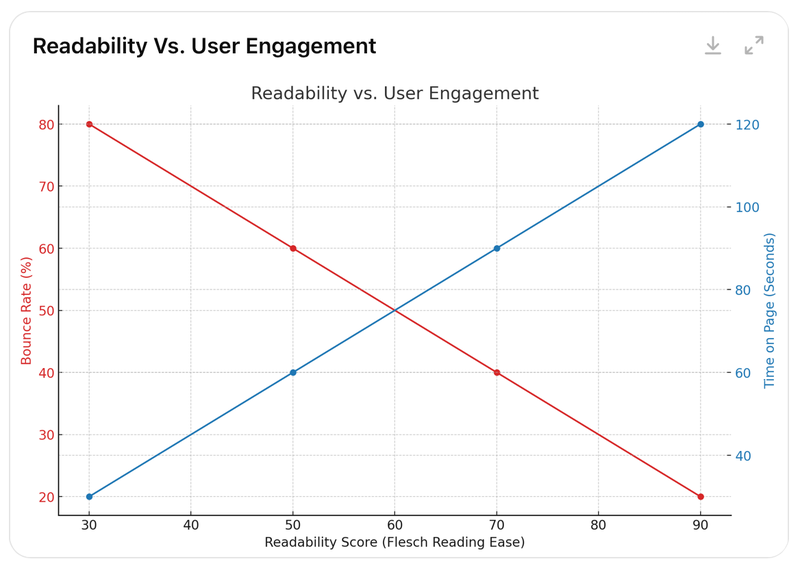
This graph demonstrates that prolonged time on page and lower bounce rates are correlated with higher readability scores.
Tools to Improve Readability
- 1. Hemingway Editor: Highlights complex sentences and suggests simpler alternatives.
- 2. Grammarly: Checks grammar and readability issues, offering real-time suggestions.
- 3. Yoast SEO: Analyzes readability and SEO, helping you optimize content directly within your CMS.
- 4. SurferSEO: Provides suggestions for optimizing content while maintaining readability.
- 5. Frase.io: Helps with content structure and ensures AI-generated material aligns with SEO best practices.
Obviously you can probably think of many more - subject to personal preference, budget, availability, experience, skills, UX - you name it.
Tool Tip: Experiment with different tools to find what works best for your content needs.
Challenges of Readable AI Content and How to Overcome Them
1. Robotic Tone and Lack of Emotion
AI content can sometimes sound unnatural. To improve:
- Add a human touch by editing for tone and relatability.
- Use anecdotes, questions, or conversational phrases to engage readers.
- Customize AI settings to reflect your brand’s personality.
Character AI Tips : Fine-tune the settings to match your desired tone, but always review and adjust manually. Remember Ernest Hemingway 's famous advice, "write drunk, edit sober."? Trouble is, Hemingway never actually said that but we hope you’ve got the point.

2. Content Flow and Coherence
AI-generated content can lack logical progression. To enhance flow:
- Reorganize content to create a clear, cohesive narrative.
- Use transition words like “therefore” or “meanwhile” to connect ideas.
- Read the content aloud to catch awkward phrasing or abrupt transitions.
Practical Tip : Reading aloud helps spot issues that may be missed during a silent read-through.
Content Testing Techniques
Testing your content is crucial for understanding what works best:
- A/B Testing : Experiment with different headlines, paragraph structures, or visual layouts to see what engages readers most.
- Engagement Metrics : Use analytics tools to measure time on page, bounce rates, and scroll depth.
- User Feedback : Conduct surveys or ask for reader feedback to fine-tune your approach.
Example : By running A/B tests on a blog article both with and without bullet points, you may find which style your readers prefer.
Future of Readable AI Content
The future of AI in content creation is fading, yet promising. Some believe we have reached its peak this year. Innovations in natural language processing (NLP) are expected to make AI-generated content even more human-like. Upcoming trends include:
- Emotionally Intelligent AI : Tools that understand and convey human emotions better.
- Advanced Content Personalization : Hyper-targeted content that adjusts based on user behavior and preferences.
- Video and Multimedia Content : AI generating high-quality videos and interactive content seamlessly.
Expert Insight : “We’re on the cusp of AI tools that will not just automate but also enhance human creativity,” predicts Mike, SEO Director at Seologist .
Mike’s colleague Yuriy Byron, Senior Content Strategist at Seologist , is more skeptical and believes that while AI can speed up content production, it lacks the nuanced understanding and emotional intelligence that true creativity demands. “AI can mimic tone and style, but it still falls short when it comes to original thought and deeply resonating storytelling,” Yuriy explains. He emphasizes that human insight and cultural awareness remain irreplaceable, especially for crafting content that genuinely connects with diverse audiences.

Best Practices for Readable AI Content
-
Set Clear Guidelines
: Define readability standards for your team and use AI tools to assist but not replace content creation.
-
Balance AI and Human Efforts
: Leverage AI for efficiency, but rely on human editors for creativity and strategic oversight.
-
Stay Updated
: Regularly review new features and updates in AI and SEO technologies to keep your content strategy effective.
Character AI Tips : Always pair AI-generated content with a human review to ensure it meets readability and engagement standards. Incurring extra expenses having to pay human editors in a short-run are to be well-compensated in the long one.
Cost-Benefit Analysis
The equation is rather straightforward - better user engagement and SEO performance follow from effort spent to make AI information comprehensible. While human editing adds to the cost, the long-term benefits, such as increased organic traffic and higher conversion rates, are often worth it. Conduct a cost-benefit analysis to determine the optimal balance for your business.
Summarizing: Striking the Right Balance for Readable AI Content
Though content development has been transformed by artificial intelligence, readability is still absolutely fundamental in good communication. The best approach blends the subtle inventiveness of human editors with the efficiency of artificial intelligence. Applying these techniques and using the correct tools can help you produce AI material that is not only understandable but also rather interesting and search engine optimized.
Keeping flexible and knowledgeable will be very vital as artificial intelligence develops. Combining automation with a human touch guarantees that your material not only performs but also really connects with your readers. Thoughtfully embrace this changing terrain and you will maximize artificial intelligence's possibilities for your content strategy.
The Role of Readability in AI Content Creation FAQs
How do I set measurable readability goals for different audiences?
Start by mapping audience segments to target reading levels (e.g., grade 7–9 for consumer blogs, grade 10–12 for technical buyers, expert-level for white papers). Pair each level with KPIs such as skim rate (scroll depth to 50%), completion rate, and time-to-first-answer. Review these quarterly and recalibrate when new formats (like newsletters or product docs) enter your mix.
What governance process keeps AI content consistently readable at scale?
Create a lightweight editorial standard (one-pager) with must-do rules on sentence length, terminology, and structure. Enforce it through a pre-publish checklist and designate an “accessibility/readability owner” who signs off on high-traffic pages. Log exceptions with rationale so the style guide evolves from real-world cases, not theory.
How can prompts and guardrails make AI generate clearer first drafts?
Engineer prompts that specify audience, desired reading level, and response format (e.g., “intro + 3 bullets + 1-sentence takeaway”). Add negative instructions like “avoid passive voice, avoid idioms” and require a 30–40 word executive answer first. Include a final self-check step: “List three edits that would make this clearer,” which the model must propose.
What’s the relationship between accessibility and readability?
Readable copy is only truly effective when everyone can consume it. Use plain language, descriptive link text, and meaningful headings, then pair them with accessibility practices like proper HTML landmarks, alt text that conveys insight, and 4.5:1 contrast ratios. Screen-reader-friendly structure often improves scannability for all users.
How do I present numbers so they’re readable, not overwhelming?
Round where precision isn’t critical, and prefer orders of magnitude (“~3× increase”) over dense decimals. Convert raw figures into ratios, deltas, or small tables with clear labels and a one-line “so what.” If a chart is necessary, add a sentence that states the conclusion so readers don’t have to infer it.
How should readability adapt across channels (email, docs, web, in-app)?
Keep the “answer first” model everywhere but change density and format by channel: teasers and bullets for email, expandable sections for web, and microcopy + tooltips in-product. Reuse the same canonical explanation but resize it to the container. Maintain a source-of-truth doc so updates cascade consistently.
How do I keep brand voice while simplifying language?
Separate voice from verbosity. Lead with clear, concrete statements, then add personality in examples, transitions, and microcopy — never in the core explanation. Maintain a phrase bank (preferred verbs, analogies, banned jargon) so clarity and brand tone can coexist without drift.
What metrics reveal readability problems before rankings or conversions drop?
Watch “time to first interaction” (how long before a click/expand), “paragraph abandon” points from scroll maps, and search-on-page frequency for key terms. Rising use of internal site search on a page often signals unclear explanations. Track these alongside support-ticket tags to catch confusing sections early.
How can localization impact readability for global audiences?
Translate intent, not just words: swap culturally specific idioms and examples for local equivalents and adjust units, currencies, and regulatory references. Keep headings parallel across languages so structure remains scannable, and set market-specific reading-level targets. Build a shared glossary to prevent inconsistent terminology across regions.
How do I reduce hallucinations while preserving readable, confident prose?
Require sources for factual claims and insert citation placeholders during drafting so editors verify before publish. Use retrieval-augmented generation (RAG) or provide a curated “facts pack” in the prompt to ground outputs. Finally, add a policy line in your checklist: “If it can be wrong, link the source or rephrase as context,” which keeps clarity without false certainty.